
No thoughts, just cuts: a pre-budget speech by Nicola Willis
Finance Minister Nicola Willis' pre-budget speech announced more public service cuts and more AI technology. It delivered a lot of deliberately sneaky language.

On Tuesday the 19th of May, New Zealand Finance Minister Nicola Willis announced planned cuts to the NZ public sector that amount to about 8,700 people. The pre-budget speech (given to Business North Harbour) also claimed some restructure of agencies was imminent. For important context, this is far from the first time that this government has made large cuts to try and find money, and it's not the first time they've taken shots at the broader public service.
What follows is a detailed breakdown of the language and presentation tricks employed in this speech. This was written for the BNH audience, but intended to be spread as an "announcement," and therefore should be considered to have a general audience that includes all of New Zealand.
Major news outlets did not discuss the entire speech, and did not link to the transcript, meaning their reporting does lack context (and citations). It's a long speech with a lot to cover. For convenience, you can jump to specific sections here:
- Early reassurances and setup
- The promise of doing something
- A shaky defence of culling
- Working is for workers
- Computers will save us
- Journalism takes a hit
- If it's broken, break it again
- A landslide of contradictions
- Thanks for your time
Please note that the first 1,200 words of this speech are introduction, and won't be examined here. It predominantly revolves around kissing the rings of the attending businesspeople, vaguely mentioning a massive list of things the government might do in the future (after being in power for almost a whole term) and taking swipes at previous governments. If you want to read this part of the speech, and you don't, it is available on the Beehive website.
My only editing comment here is that if someone can cut 1,200 words from your speech and lose nothing important, you're not very good at giving speeches. And that a speech intro over 1,000 words is shoddy work.
Early reassurances and setup
A driving goal for our Government is to deliver better public services for New Zealanders, not by just blithely spending more, but by driving better results from the spending we already do.
Right from the start of this section, we immediately see the word 'blithely' used to describe how (previous) governments have spent money. This is intentionally dropped here to tie back to a comment in the very-long-introduction about their rivals wasting money on cost-of-living payments. It's also quite a fancy word, as in you are more likely to hear it in the company of the rich. You know, like Business North Harbour. Fancy not being the same as posh, of course.
The phrase 'the spending we already do' is meant to connect to this overall sense that too much money is getting thrown away. Spending has a negative connotation in the minds of many, even though spending money on goods and services is objectively good, especially for a government.
Our perspective is simple: a Government’s compassion shouldn’t be judged by the size of the cheques it writes on your behalf, but rather it should be judged for the results it gets for that spending.
Ensuring value for taxpayer money shouldn’t be a radical position, but the need to re-state it is evidenced by recent history.
This use of 'compassion' means the speaker, Willis, wants you to see the government as compassionate, caring, human. A very defensive type of framing, and betrayed immediately by the rest of the sentence. Here we see a comparison between two items that are not directly comparable: big cheques and government results. Cheques written on my behalf by government are results, of course, even if you don't like them. If this were a political critique, I might mention that this government has been criticised (judged) specifically for not delivering results quite a lot already.
Both these sentences put a 'but' in the middle of two conflicting ideas, and a good rule to follow is that everything before the word 'but' in this sort of sentence can be ignored, because their real opinion is that last bit. What they are actually saying is "A government should be judged on results." and "It's annoying that my position on cutting spending is radical now."

Most people these days don't need a primer on what the word 'radical' has come to indicate, but I will note that bemoaning your position becoming radical is often a way for the speaker to signal that they are normal and other people are crazy for not agreeing.
Here we skip over a few paragraphs of bitter attacks on the Labour government, none of which add anything... because we still haven't really announced anything. Then there's this bit:
To put that into context, that growth in public sector roles outpaced job creation in the private sector at a ratio of almost three to one. Worse, most of the growth occurred in the back-office, with ballooning costs for policy analysts and consultancy invoices, rather than for frontline positions.
We have the first of many, many uses of the 'back-office' phrasing. Now, there's nothing outrageously different between back and front office jobs, but it's important to know that the distinction Willis is drawing here is always between 'back-office' and 'frontline' roles. That is, a comparison between office workers and real workers like nurses and teachers. Within this framing is the quite complex line that
- back-office jobs are mostly a waste of time
- frontline workers are important
- there isn't enough money for frontline workers
- it makes sense to take wasted money from the office workers and give it to frontline staff.
The logic holes here are catastrophic, which is why it makes more sense to just say 'back-office' and never explain yourself too much. For one thing, this National government has consistently cut resources that would help those frontline services, and fought against better pay; any suggestion that they personally care about fixing those problems is provably, factually inaccurate. For another, office jobs aren't a waste; hundreds of thousands of public servants have roles that are vital to the infrastructure of many local and nation-level systems. Talking about the 'back-office' as if it's some messy problem sucking up money is like telling your mechanic to remove your car's engine because "the wheels are the important bit."
Using 'ballooning' is another manipulation tell, by the way. It's dramatic in a way that means to override logic and produce an emotional response. Oh, the costs are ballooning? That sounds awful and makes me angry. Obviously this is also an uncited claim. Are they ballooning? Where? To what extent has the balloon been inflated? None of these answers exist in a meaningful way, and that's purposeful. You aren't supposed to think about this, you're supposed to feel about it.
I would mark all of these types of examples with a [citation needed], but there are just too many.
'Consultancy' is also mentioned here as a balloon, which is darkly funny considering the main contributor to consultant contracts is job cuts. Reduce your resources without reducing the work and you will need to fill that resource gap. You'll probably have to fill it fast, necessitating the need for someone to be contracted in quickly, and for a lot of money. It's always good to keep track of how many contradictions and hypocrisies a speaker keeps in their words.
Since being elected, this Government has been on a mission to reverse those trends. Our belief is that you don’t need to break the bank to get better results.
It has been almost a full term since this government was elected, but the word choice here is designed to do double duty: it implies they've been working consistently hard, and it shrinks the perceived time they've had to do it. They only just got elected, after all; there's simply been no time. Don't look at all the nothing they've accomplished, instead you can focus on the visionary mission ahead. There is a lot of this kind of rhetoric from incumbent politicians when elections are looming, because you have to say that things are going great because of your work, or you need to say there's more work that only you can do.
Another one to watch out for when reading political statements.
'Break the bank' is an awfully trite phrase, but it's again here to emphasise that the other guys are bad with money and we are good.

That belief may be poo-poohed by my Opposition colleagues but I know the people in this room get it.
Your mission for increased productivity isn’t a debating point, it’s essential for staying in business.
You think carefully about every extra dollar you spend and seek to constantly squeeze more bang out of every buck.
Right here Willis launches into another ingratiation session, with a lot of phrases that make it clear she is on the audience's side, that she supports the businesses above all. Telling them that they 'get it' and reinforcing that with compliments about them being careful thinkers is a pretty common ploy.
I agree with you. And you're smart. That must mean you agree with me, which would be the smart thing to do here.
The second sentence here, about increased productivity, is a bit interesting because it's structured exactly like a common sort of generative AI output. "Blank isn't [just] thing, it's even bigger thing." The technology spits out a thousand different versions of this in many different contexts. While I have no evidence one way or the other on Willis' speech having been near a genAI system, it's always curious to me that people closer to the executive class (managers, CEOs, ministers) already talk in the repetitive way that generative AI systems are copying.
Again, 'bang out of every buck' is just such a lazy phrase. That's all.
The promise of doing something
When we came to office the Prime Minister set clear targets for the outcomes we want to achieve from the public service. We are rigorous in measuring our progress against them, and in prioritising our resources to achieve them.
We’ve had an ongoing focus on stopping poorly targeted spending and have put every new idea to the affordability test.
These paragraphs are a hoot, because you rarely see so many words in one place pushing the idea that nothing has happened yet. They are 'rigorous' in measuring the 'progress' that might potentially have happened, and they are 'prioritising' but not actually doing. Don't worry, though, there's an 'ongoing focus' and things have been tested. All of this is here because they can't claim actual progress or movement on these things, because there isn't any.
What follows this is an extended self-aggrandisement, wherein Willis waxes statistical about how good the government is at policing, hospitals and education.
In education, we’re driving reforms to bring back a structured approach to teaching reading, writing and maths. The early results are exciting. Attendance levels are up, maths students are making faster progress and new entrants are reaching literacy benchmarks in far greater numbers. Through modern delivery we’ve significantly reduced the cost of building new classrooms.
You'll see that the first sentence here refers to bringing back a 'structured approach' for school subjects. A following sentence then mentions 'attendance levels,' conflating the two ideas. Attendance has no direct correlation to learning structure changes, and these attendance lifts were created by introducing heavy penalties for schools and students who failed to address attendance. The implication that attendance was improved by curriculum changes is therefore a lie, despite not being explicit.
Our first two Budgets included $44 billion of redirected spending. We’ve driven hard to reduce back-office costs: spending on consultants is down $915 million, clerical and administrative positions are down 15 per cent, managers are down 6 per cent and policy analysts are down 10 per cent.
Numbers come thick and fast in these paragraphs, and it's important to remember that it's easy to use numbers to impress or bamboozle an audience without really saying much. Numbers are often a smokescreen for lack of content.
Again we see 'back-office' thrown under the bus here. The speaker, Willis, assured that you agree with her that an office worker is wasteful and unnecessary. She proudly states all the numbers that happened, and deliberately or accidentally provides an incomplete list of jobs she has no respect for: clerical, administration, management, policy analyst. Cuts here are not just needed, they are great. Something to boast about. Even the most finely-crafted flimflam speech stumbles over some truth about the author.
What this shows you is that, even with more limited resources, our public service can achieve a lot. I can tell you honestly that some of New Zealand’s best, brightest and most publicly-spirited individuals are employed in our government agencies. With good leadership at the top, they are capable of extraordinary things.
Enough about truth, because this paragraph is reassurances that Willis and the government actually love the public service. Overflowing praise that would look alright as an opening, but it rings hollow when placed right after a comment about how excited you are to have so many of them unemployed. It also reads as too effusive given the context; trying too hard to convince the wider audience of something that isn't true.
A warning to aspiring politicians: 'honestly' is another tell. It has a touch of insecurity that can betray the reality, which is that you're not being honest.
We can, of course, assume that Willis is not referring to good management here (who have been reduced 6 per cent already). She means herself, and the current government. It has a scent of needy energy to it, as if the audience agreeing would make her feel better.
Our Government is as frustrated as you are by the fragmentation and silos, the complexity, the status-quo thinking and the dangerously slow take up of digital and AI technologies.
Opening with 'our government' here is an attempt to lump actual government functions in with the thoughts of Cabinet and ministers. See! they're also frustrated! Since none are capable of confirming or denying this at a Business North Harbour meeting on a Tuesday, we will have to simply assume that all public servants actually agree with this general list of undefined problems.
'Complexity' is borderline nothing, as everything is complex in some way. Stating that 'status-quo thinking' is a problem has a truly nasty manipulative edge to it, as it could really mean anything currently happening that I, the reader, do not like. Two people listen to the speech, one hears agreement with destroying the 'status-quo' of too many regulations, another the 'status-quo' of slow emails.
I find the use of 'dangerously' here deeply strange.
There's a vague sense that not keeping up with technology could lead to a risky situation, which is ephemeral enough to either be true or false. What exactly is she attempting to imply? No doubt some scenario where the public service didn't try a new Microsoft Office application and caused a 30-car pileup on the state highway.
Finally, of course, we get to a mention of generative AI. It is generative AI (or genAI) by the way, not 'AI.' Artificial intelligence encompasses a wide range of disciplines across many subjects, and arguably doesn't include things like probability-driven chatbots. Regardless, genAI works, as does LLM (large language model) when talking about the technology running such tools.
In too many parts, the back-office of Government still looks like an eighties relic, run on old-fashioned systems, with slow bureaucratic processes that are too often about box-ticking rather than improving outcomes.
Once again, the 'back-office' is here to reinforce that negative connotation. And now we're also implying we could fix it with amazing technologies, removing the need for all that waste. It's good to be aware of all the implications behind word choices for this reason, you find out what people are actually saying when they won't say it.
Willis shows her general time on this planet here, and a lack of knowledge of the speed of development, by calling parts of the public service an 'eighties relic.' Hard to know what this would be referring to, and I suspect she simply forgot how long ago the 1980s were. Which relic do we mean here? Dot-matrix printers? Rotary phones? Smoking? The charitable reading is that this is hyperbolic shorthand for old-fashioned, except she says 'old-fashioned' in the same sentence. So either she goofed, or she thinks her audience is stupid.
'Box-ticking' is another annoying phrase. Its intent is to message that there shouldn't be pointless work for work's sake. However, with no context it sounds more like a government that wants to remove good and bad processes so they can point at it and boast about the lack of box-ticking.
Good to note that a lot of the 'box-ticking' in public service positions is useful and necessary for keeping a country running.

A shaky defence of culling
In truth, we are reaching the limits of the current public service operating model.
'In truth' sits alongside 'honestly' in the Hall of Things You Say When You Mean The Opposite, just so you know.
This sentence makes the public service sound like a terminal cancer patient or an old car, which is no doubt the intent. They're looking for an emotional response again. Won't someone do something about this?!
Comparisons are not exact, but New Zealand has, by latest count, 39 departments and ministries administering Budget lines. That compares with 16 in Australia, 24 in the UK and around 12 in Finland.
Saying 'comparisons are not exact' is a particularly disingenuous (lying) way to say something is not a good comparison. But what do they mean to achieve here?
More departments equal more managers, more HR departments, more comms teams and more administrators. More departments also equals more statutory compliance requirements, more silos, more inter-departmental consultation and more costs for the citizens and businesses forced to multiply their interactions with government.
They want to cut departments down primarily to cut jobs, basically. No more 'more,' only more less. This betrays the misleading nature of the numbers above. According to International Labour Organisation (ILO) figures, picked up in summary from Wikipedia, New Zealand has 18.9% of its total workforce in public sector roles. The UK has 23.9%, Finland has 24.9% and Australia has 28.9%.
NZ is ranked at 51st place on a list of countries ordered by the relative size of their public service. So whatever your opinion on cutting jobs, Willis' comparison is another lie dressed as fact. Numbers are fun, but you can use them to tell whatever story helps you sell your message. Be aware of it.
The Public Service Commission Te Kawa Mataaho advises that a vital factor in the size of the public service is population size. Which is none of the things mentioned by Willis.
This part is also an expansion of the list of things Nicola Willis—and the government—doesn't like or value: departments, managers (again), HR, communications, administration (again), compliance requirements, silos, consultation and interactions.
Working is for workers
Following today’s announcement, public service agencies will be asked to come up with proposals to logically merge their existing activities around citizen-facing functions, using common technology platforms. We expect to announce more detail in the coming months.
Reading that agencies will have to 'come up with proposals' should be a giveaway here. Much like the idea guy at a company, this is an indication that Willis and the government have invented the concept of someone else thinking of the solution. And it was a problem they invented, which is particularly galling. It should make you consider how the government knows for sure that there is government waste, but doesn't know where it is, what it is, or how it would be fixed.
This sort of vague communication almost always means the person made up the problem they're talking about. Otherwise they'd give more details.

Merging the Ministry of Housing and Urban Development, the Ministry of Transport and the Ministry for the Environment will reduce duplication and ensure a faster, more integrated approach to issues like housing affordability and climate adaptation. It will also create significant savings along the way.
The Ministries of Housing, Transport and Environment merging together and somehow reducing 'duplication' is a huge [citation needed] situation. If you're making unsubstantiated claims in speeches and you want the benefit of the doubt, you need to provide plausible examples. If you're listening to these claims, you should demand that as a minimum. This example is nonsense.
'Significant savings' is a little [citation needed] and a little wishful thinking.
Computers will save us
Goal number two. We’re going to ensure government is fully on board the digitisation and AI revolutions sweeping the world.
'Fully on board' is quite aggressive language, as it implies that anything less than 100% commitment will be unacceptable. This is a pretty strange stance to take on what amounts to digital tool upgrades for organisations. Especially when you don't actually know what those upgrades will be, or if they will be. When folks are very insistent about something in their communication without offering a reason (e.g. "you must wear a seatbelt because it is a safety concern") you can often trace that to desperation or the person speaking not wanting you to know their reasons. Either of these is suspicious.
Another sneaky coupling trick here, where two ideas are dropped next to one another to make you associate them strongly. Here we have revolutions for 'digitisation' and 'AI' pinned together as if they are equivalent.
The digitisation revolution, as it were, is unquestionably a useful development, as it improves efficiency across many workplaces. Nobody would argue in good faith that computer tools and digital archives have not been helpful. generative AI is chatbots, cobbled-together photos of imaginary people, sloppy posters and the promise of amazing features that you aren't allowed to ask about just yet.
While New Zealanders are increasingly conducting more of their business digitally, the public sector hasn’t been keeping pace. For too long, the public service has been scared of AI, slow to move to the cloud, and has procured a complex and fragmented set of overlapping IT solutions.
Right away we see the same trick again, throwing the idea of conducting 'business digitally' with 'AI,' even though they are two different things. Just because I say there's been a downturn in CD sales and basketballs doesn't mean they're connected.
The same goes for the idea of the public sector not digitising fast enough, and them being 'scared of AI.'

A line is being drawn between a public service that fails to modernise fast enough (which may or may not be true) and one that isn't using generative AI technology in specific. And, perhaps more annoyingly, this is sensationalised here as being 'scared.' This is actually a bit of genAI rhetoric sneaking into the political rhetoric here, as it's a common sales tactic by genAI companies trying to shock people into buying in. Like when Biff calls Marty McFly a chicken in Back to the Future.
The Chief Digital Officer will oversee investment in digital systems to move human resources, payroll, case management and other systems to the cloud and to embed AI deployment as a basic expectation for all public entities.
Beating a dead horse to say this sentence also conflates two things for the purposes of trickery. Anyway, there's a few of things going on here.
One, the very specific sentence structure here is doing a lot of work to make this seem like a commitment, but the words themselves are straightforward in their meaning: we are promising to invest in the idea that something might happen. I'm not promising to clean the dishes, I am allocating a Chief Dishes Officer to oversee investment in dish systems to move dishes to the cupboard. Two, the phrase 'AI deployment' is tactically vague; it could mean mandating staff to use genAI tech, or it could just mean giving staff access. If it's the latter, and it isn't used, then you might as well be doing nothing at all. Three, 'expectation' is also open-ended; something can be expected but not required.
Basically, this is exactly the sort of collection of words a speaker uses when they want to sound proactive but don't want to commit to anything.
Journalism takes a hit
An example of what is possible is the recent trial of an AI scribe tool in hospital emergency rooms which has reduced the amount of time clinicians have to spend on file notes and increased the time they spend with patients. Feedback from doctors and nurses has been overwhelmingly positive.
To pivot slightly from the other points, this is a direct reference to an actual pilot rolled out to the NZ health system by the government. It correctly says 'recent,' as the trial began in October of 2025, a scant 7 months before this speech and not really enough time to have actually gotten results from any trial. In fact, there are no results yet, as far as I can tell (if I'm wrong, please point me in the right direction). So where is this 'feedback' coming from? It's not really clear. It could be referring to interviews done with the trial participants [1] that haven't been reported, which would be somewhat underhanded. Or it could be referring to participants in a smaller trial [2] that preceded this trial, where a much smaller group (10 clinicians) tested the tool, meaning you are only relying on a vanishingly-small sample size. Finally, it could be information directly from the company that makes the tool [3], which would make it a biased sales pitch.
The rollout was reported widely, including in this RNZ article: AI scribe tool rolled out to emergency departments, promises to slash clinicians' admin ↩︎
Sensationalist headline and questionable source, but this was one of the only places I could find concrete details of the first trial, and it's only in an interview: Public emergency clinicians 'begging' to try AI scribes) ↩︎
I've got no access to Heidi press releases, if they exist, but this is their website: Heidi Health ↩︎
Whichever source is accurate, the data is flawed.
On top of this, consider the difficulties involved in actually verifying this information. If a member of the public wants to find out about this amazing new tool that is improving hospitals (or rather, find out that isn't true), they need to read a handful of news articles on several different websites, none of which cite to their sources for the original information. Reports of positive feedback merely floated in on the wind. This is as much a black mark on NZ journalism as it is politics; citizens can't be expected to stay informed if the seekers of truth don't seek. Didn't any journalists think it was weird, for example, that there's no report available for that initial trial? Did any ask what the process was for determining the boundaries of the trial? Or for the process for choosing Heidi to provide the technology?
We might never know. Isn't that a bit scary?
If it's broken, break it again
Goal number three. We’re going to get public servant numbers back in step with historic norms with a focus on hiring and retaining talent.
Getting back in step with 'historic norms' here refers to the idea that the NZ public service is now bloated and oversized, but it used to be good. Obviously this makes the massive assumption that you think the historic state of the public service was good in the first place, but it also uses 'norms' to make it clear that things were normal and now they're different, and therefore abnormal. It's very important that you know how normal things used to be, back in the Whenever We Are Talking About.

Using terms that invoke a nostalgia for how society ran in the past is often a dog whistle for ideologies like fascism. Which is not to say the current government displays fascist tendencies, or that they don't. It's simply something to keep in mind as you navigate these sorts of announcements.
Claiming a focus on 'hiring and retaining' talent in the middle of an announcement about drastically shrinking the public service is comically terrible. But, it's important to note that this too is a communications tactic. Bringing this up here softens the cuts by giving the illusion they are cutting the "waste" and reinforcing the good parts of the public service. There are no such promises, because only the cuts are being promised. A good rule is to not extend yourself to make someone else's argument for them. Willis did not detail how the cuts would be offset by improved hiring; she did not suggest that any of the cut roles would be refilled or replaced; she did explicitly state that 8,700 jobs had to go in order to reach an arbitrary-but-specific number.
Oh, and it is ridiculous and disrespectful to your audience to laud 'historic norms' while also chastising the public service for not running to modernise. Contradictory and hypocritical.
We are going to going to bring renewed focus to the essential task of attracting, retaining and developing public service talent.
The Public Service Commission is already working to identify and develop future public service leaders, is actively tracking our 100 highest potential leaders, and will soon launch a public service academy to professionalise its talent-development efforts.
At the same time, we’re going to pull the brakes on the increase in overall public servant numbers.
One could perhaps say that 'attracting, retaining and developing' talent is just a normal part of doing business or running an organisation of any kind. The fact that it's being used here as a selling point is another assumption that their audience isn't very smart.
Beyond that, there are many phrases here that qualify as fluff. Meaningless filler material that either is designed to take up space or give the impression (but not the action) of doing something. Identifying and developing 'future public service leaders' does not mean anything; tracking 100 'highest potential leaders' does not mean anything; launching a 'public service academy' does not mean anything. These are all just plausible enough to present the illusion of Doing Your Job, but, even if they do or will exist, they're vapour.
The final sentence then says it will 'pull the brakes' on the 'increase in overall public servant numbers,' instantly and directly contradicting the previous two sections. We're trying to get more staff, but we will not be hiring more staff. We need to develop more leaders, who we will then make redundant to hit our targets.
Historically, New Zealand’s core public service has equated to about 1 per cent of the population. After a period of largesse under the last Government it now hovers around 1.2%.
'Core public service' is a key phrase being used to justify and explain these mandatory ideas (I almost typed "decisions" but they're not decisions because no deciding occurred). What is the 'core' public service? Well it's nothing. No such term is in common use across politics or media in New Zealand. The implication is that this is the wasteful, useless parts of the system. Confusing, as 'core' implies something vital and necessary, something not to be risked with frivolous cutbacks.
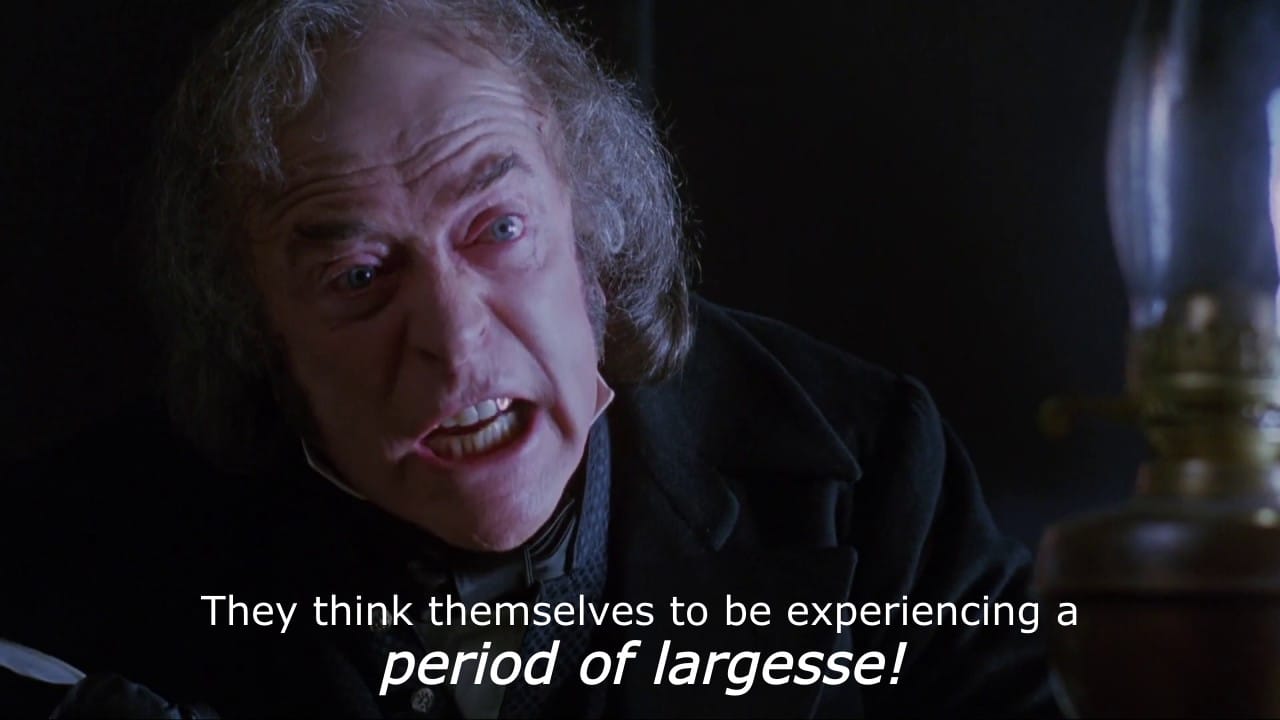
Compared to all the words around it, 'period of largesse' sounds transported directly from the Victorian era. I can see Ebenezer Scrooge complaining that his employees are slacking off under a period of largesse.
One of Labour’s first moves was to remove the cap National had previously put on the number of people employed in government administration. Unsurprisingly, that spurred a huge hiring spree, with the number of workers in service support roles rocketing up by 46 per cent.
More mentions of what National apparently hates: administration (third time) and services support roles.
Here we also see another hyperbolic turn of phrase designed to convince you that hiring people is a bad idea. Can you believe they were hiring people? For jobs? We don't do that around here.
A landslide of contradictions
That’s unsustainable, it’s unaffordable and it’s out of step with international trends.
In Canada, Mark Carney’s government is reducing the size of the federal public service workforce by 10 per cent over the next few years. In Singapore, growth in the public service is pegged to not exceed overall growth in the labour force. The UK is systematically shrinking administrative budgets.
This section piggybacks off the previous assertion that there was a hiring 'spree' and firmly states this is 'unsustainable.' There's no evidence of this, or the spree. It's a good example of a speaker layering multiple statements that are false, unverified or unverifiable so that each new statement can't ever be said to be made up, as such. Actions like this are marked as 'out of step' so that we can also be convinced that everyone else already agrees. All the cool countries are cutting jobs.
In argumentation theory, this is known as the argumentum ad populum fallacy, a logical fallacy where something is said to be true because a volume of others agree with it.
The examples here aren't even particularly strong, and if this was a formal communication I was editing I would probably recommend not including this point. If your examples can't support a message, you might just be hurting the message by drawing attention to that. Canada 'is reducing' the public service, meaning they have not done so, and have not measured the effects; Singapore's public service is 'pegged' to 'not exceed overall growth' in labour, which means there is a prediction, by someone, that public sector numbers will grow but not grow a lot; the UK is shrinking budgets, but not necessarily jobs.
Our Government has therefore set a goal to get our core public servant numbers back to the historic norm at 1 per cent of the population, roughly equivalent to what it was before Labour took office.
Of course, we note the return of 'core public servant numbers,' a term that has yet to be defined in this speech, and is not visibly defined into common use. We are moving this nebulous category back to the 'historic norm' (see above for a breakdown of this loaded term) of 1%. Coincidentally, this is the number it was at when the last National government was in power.
We will be tracking progress towards a numerical target of no more than 55,000 full time equivalent public service employees by July 2029. That’s 8700 fewer than were employed in December last year.
Now the phrase 'numerical target' here is like a golf ball to the brain stem. Numerical target, specifically. We have already been talking about numbers, and most people already will have assumed this would be about a number of jobs. So why specify a numerical target? Why use the word numerical at all, in fact? It's awkward. My one guess is that this was borne of a need to make absolutely sure nobody could argue there were better ways to make public service organisations efficient and effective. Don't talk to me about improving processes or training or—god forbid—more resources; I said the targets were numerical. Numbers only.
This part of the speech also tries to sweep past the numbers themselves, ironically. 55,000 is an entirely arbitrary number that only exists because it was the rough number corresponding with their last turn in office. Despite being controlled, in many ways, by the government of the day, New Zealand's public service is a different entity, and does not logistically run on the clock or decisions of switching governments. It is a collection of organisations that function regardless. That's kind of the point. Additionally, there's no mention of any research done to reach this number, no consideration of whether it is actually the correct number of people required to do the work requested. You can't give people 10 caterpillars today and ask for 100 butterflies tomorrow.
Let me stress that these targets apply to the core public service and do not include teachers, nurses, doctors, police or people employed by Crown entities. We fully expect that with good budgeting we will be hiring more nurses, police officers and others in critical frontline roles.
'Core public service' once more, but now, miraculously, we are given a definition of this category. Anything that doesn't include teachers, nurses, doctors, police or the staff of Crown entities. You may recognise the first part of this list from earlier, when Willis was praising the government's accomplishments. Their mention here solidifies the purpose: these are the categories of worker that our voters actually care about, and they are miraculously preserved. It's a coincidence.
Then we get another very bold series of tricky words, all designed to obfuscate something. The government claims they are going to hire nurses, police officers and others in 'critical frontline roles,' which they put at the end of the sentence. Why? It weakens the claim, and weakens the audience's desire to question it. This isn't so important, it's at the end of the sentence. The caveats come first. They 'fully expect' this to happen 'with good budgeting,' so if our expectations don't match the reality, it was just a money issue, not our fault, because we 'will be hiring.'
How will we achieve this reduction in numbers? By doing the things your business considers routine: allowing for natural attrition, stopping duplication, streamlining back-office functions, accelerating uptake of digital tech and requiring government agencies to report every quarter on their progress towards the targets.
Brace yourself, now, because we're deep in the muck now. This is where the previous manipulations really have to work hard, because Willis is detailing what they actually will do. 8,700 jobs will disappear via 'natural attrition.' Okay not a strong start, this is just saying that these jobs will cease to exist because people will stop doing them. They will also go when we stop 'duplication' (whatever that means in this context), 'streamlining' back-office functions (which is just saying "we will make the thing work better somehow"), accelerating uptake of digital tech (something that does nothing inherently to eliminate the need for jobs), and requiring agencies to 'report' on their progress a lot.
If this wasn't a speech, you might expect someone to ask Minister Willis how waiting, making something better somehow, recording cuts you already made, and turning on more computers is going to delete 8,700 jobs. But you can't, because it is a speech, and that's probably one reason why.
Thanks for your time
A modern, high-performing public service that is more connected, productive and efficient, and that ensures more resources are directed toward better outcomes for New Zealanders.
As this haphazard speech slowly winds down, I only wanted to mention 'modern' because it clashes entirely with the previous comments about historic norms and the idea of returning to a better time. Editorial note would be to pick a side on this and only base your messaging on that.
'More resources' is also particularly irritating at the end of a speech that was broadly about telling NZ that they are absolutely not getting any more resources for any reason. The entire thread of argument from Willis is actually that they are taking away resources, and it seems extremely rude to think that you can just say the opposite in your closing, expecting people to swallow it.
We’ll also deliver some big savings. To reflect and drive the efficiencies expected from these reforms, this year’s Budget reduces most agencies’ operating budgets by 2 per cent in the coming year, followed by a further 5 per cent in each of the following two years.
Another thing speakers will do is attempt to bamboozle an audience by downplaying the dependency of a point or action. For example, saying you will be able to cut 'operating budgets' by 2% is very different to saying "we have reduced operating budgets by 2% based on the unsupported assumption the cuts we haven't made yet that are based on no data will produce efficiencies that don't exist yet.

Those savings add up, and have created significant headroom for higher-priority investments, a total of $2.4 billion over the forecast period, averaging $597 million a year. These savings will now be deployed to better purposes – to delivering more services in our health system, to increasing educational resources for our schools, to building infrastructure and strengthening our defence force and police.
'Those savings add up' here means "these potential savings will hopefully add up" and 'have created' means "will hopefully create." Since none of this has happened, talking about the savings as certain past events also qualifies as a blatant lie. Similarly, 'these savings' have not happened, nor have the apparent triggers for them, so the 'better purposes' are irrelevant.
Luckily, there's still time to mention the protected things that voters like: health, schools, infrastructure and police.
Some like to pretend we can have all that investment without saving a dollar elsewhere. They’re wrong. Their promises don’t add up, and the future they invite is bleak: a future of increasing taxes, heavier borrowing, shaky finances and unaffordable debt.
Nearly done now, but first we have a fun little trick called Just Making Things Up. Willis says that 'some like to pretend,' and it should be reasonably obvious that this isn't something anyone is pretending or thinking. Also, the implication is that this imaginary person is faking it, that they are only pretending to appreciate investment over savings. Once you've swallowed the line about a fake person who fakes thinking about fake topics, Willis tells you the truth: the fake person is 'wrong.' That fake person pretending to think fake thoughts is inviting a bleak future. Only the current government (so Willis assures the audience) can be right about the fake investment thoughts that fake people are wrong about.
Sensible political leaders owe it to Kiwis to face seriously into the increasing volatility of a changing world. We simply must ensure our own house is in order and that our government books are under control. We must do the work now to ensure we can face the future with confidence.
'Sensible political leaders' brings us more or less to the close of these remarks. Another not-very-subtle push to make sure you know, without her actually saying, that National are the sensible leaders in mind.
The phrase 'ensure our own house is in order' is a curious inclusion here at the end, as it is supposed to imply that the NZ government shouldn't get distracted by grander world concerns while we have problems at home. Not necessarily right or wrong, but it is a phrase used by political people to dismiss world issues that they don't want to talk about. Given the context, the most likely (but not only) interpretation is that Willis wants us to not worry so much about the fuel crisis or the messy, corrupt, US and Israel-led war causing it. The real problem is that there are too many public servants and not enough genAI bots.
After a somewhat exhausting journey through this pre-Budget speech, I hope some of the ins and outs of political language and manipulative communication are a little clearer. Speeches like this one are constructed so the speaker can avoid being held to account for the contents, but everyone deserves to be informed and empowered to take their own political actions.